Thursday, October 8, 2026 ยท VarnaGet the free weekly brief โ†’

Zulvata
Bulgaria for Bulgarians All Over the World
๐Ÿ‡ง๐Ÿ‡ฌ Worldwide
๐Ÿ‡ง๐Ÿ‡ฌ Bulgarians around the worldโ€ข๐Ÿ‡ฉ๐Ÿ‡ช Germany ~400,000โ€ข๐Ÿ‡บ๐Ÿ‡ธ United States ~250,000โ€ข๐Ÿ‡ช๐Ÿ‡ธ Spain ~125,000โ€ข๐Ÿ‡ฌ๐Ÿ‡ง United Kingdom ~120,000โ€ข๐Ÿ‡ฌ๐Ÿ‡ท Greece ~75,000โ€ข๐Ÿ‡ฎ๐Ÿ‡น Italy ~60,000โ€ข๐Ÿ‡ฆ๐Ÿ‡บ Australia ~30,000โ€ข๐Ÿ‡จ๐Ÿ‡ฆ Canada ~25,000โ€ข๐Ÿ‡ณ๐Ÿ‡ฑ Netherlands ~25,000โ€ข๐Ÿ‡ฆ๐Ÿ‡น Austria ~20,000โ€ข๐Ÿ‡ง๐Ÿ‡ฌ Bulgarians around the worldโ€ข๐Ÿ‡ฉ๐Ÿ‡ช Germany ~400,000โ€ข๐Ÿ‡บ๐Ÿ‡ธ United States ~250,000โ€ข๐Ÿ‡ช๐Ÿ‡ธ Spain ~125,000โ€ข๐Ÿ‡ฌ๐Ÿ‡ง United Kingdom ~120,000โ€ข๐Ÿ‡ฌ๐Ÿ‡ท Greece ~75,000โ€ข๐Ÿ‡ฎ๐Ÿ‡น Italy ~60,000โ€ข๐Ÿ‡ฆ๐Ÿ‡บ Australia ~30,000โ€ข๐Ÿ‡จ๐Ÿ‡ฆ Canada ~25,000โ€ข๐Ÿ‡ณ๐Ÿ‡ฑ Netherlands ~25,000โ€ข๐Ÿ‡ฆ๐Ÿ‡น Austria ~20,000โ€ข
News

Drones sank one ship and set another ablaze off Bulgaria. What we know

A combined sea-and-air drone attack left one merchant ship sunk, ten sailors missing and a second vessel burning in Bulgaria's Black Sea economic zone. The evidence has not yet established who launched it.

By Zulvata ยท Thursday, October 8, 2026 ยท 7 min read
Drones sank one ship and set another ablaze off Bulgaria. What we knowNews

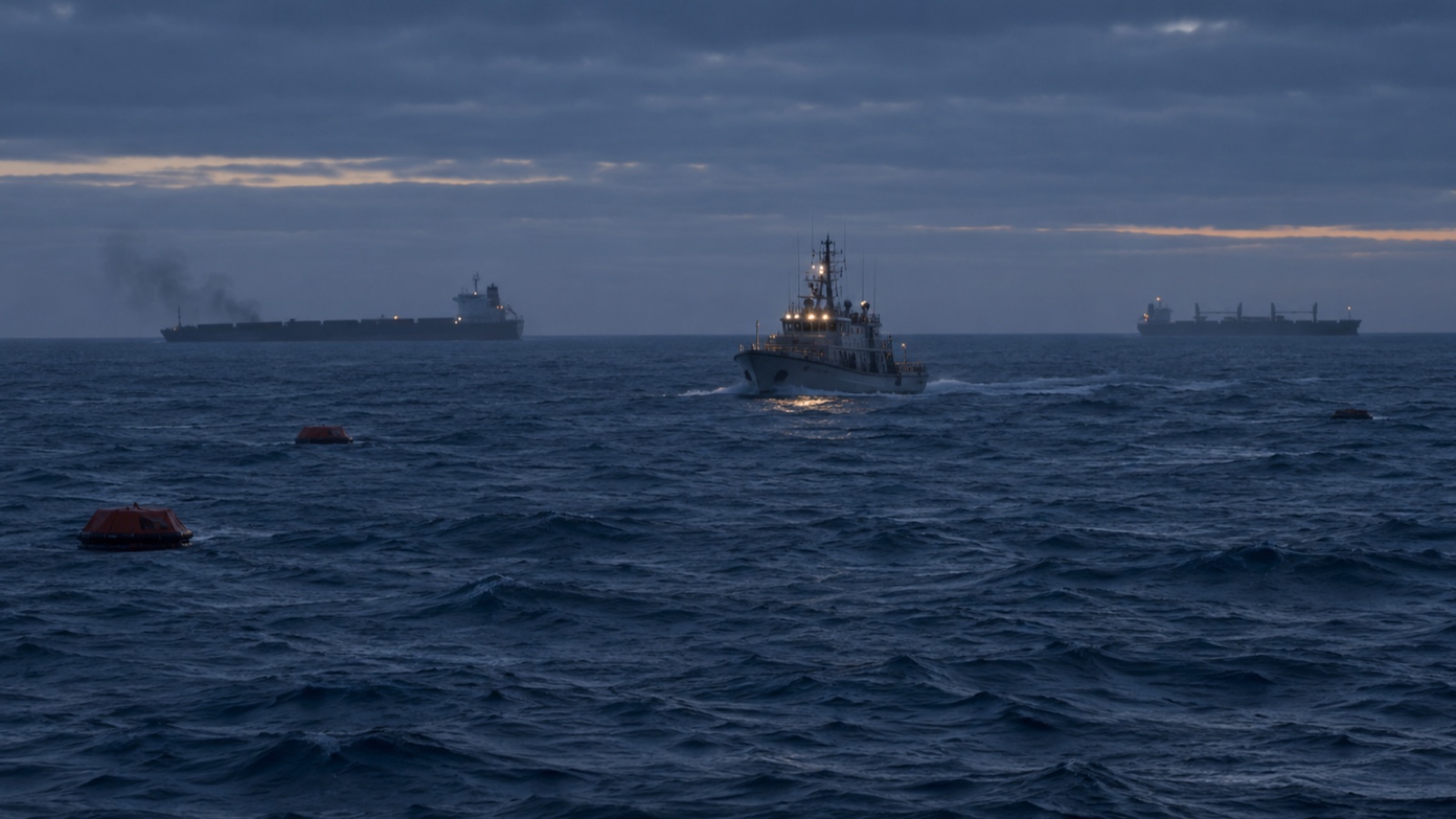
At 2:54 a.m. on Tuesday, October 6, a distress beacon began transmitting from a cargo ship in the Black Sea. Less than half an hour later, another ship nearby sent its own distress call. One vessel sank. The other caught fire, and all 18 people aboard were pulled to safety.

The two merchant ships were struck about 70 nautical miles east of Byala, inside Bulgaria's exclusive economic zone. Bulgarian officials say both sea and aerial drones were used. It was the first attack on commercial shipping recorded in that part of Bulgaria's Black Sea zone, and it arrived one day after another cargo ship sank following a suspected drone strike off Romania.

Who launched the drones remains unresolved. Ukraine says Russia carried out the operation. Russia denies that the ships were among its targets. Bulgaria says it does not yet have the physical evidence needed to name a perpetrator.

Two distress calls, 29 minutes apart

The first ship was ALFA WATAN, a Togo-flagged general cargo vessel built in 1976. It was sailing north from Egypt, through Turkey, toward the Romanian port of Sulina. Bulgarian rescue officials said its distress signal was received at 2:54 a.m.

The Bulgarian-flagged passenger and cargo ferry DIOSCURIA was nearby. Its crew saw an explosion and changed course to help. They found an overturned lifeboat, three life rafts, life jackets and floating debris, but no sailors.

ALFA WATAN sank within minutes. Defence Minister Dimitar Stoyanov later said the speed of the sinking suggested either massive damage or a dangerous cargo, but the ship's load has not been firmly established. Prime Minister Rumen Radev initially said it was unknown. Later accounts diverged, with Stoyanov referring to wheat and a Syrian maritime source reporting salt. Bulgarian National Television reported that there was still no official cargo confirmation.

The second distress call came at 3:23 a.m. from ABLE, a Palau-flagged cargo ship carrying wheat south. A sea drone reportedly hit the stern, flooding the engine room, while fire spread aboard the vessel. DIOSCURIA took all 18 crew members off the ship. Bulgarian forces later transported them to Varna in two groups: two injured sailors first, followed by the remaining 16. One sailor had burns and another suffered a head injury. The crew included Turkish and Indian nationals.

That sequence explains an early discrepancy in reports that listed either 16 or 18 survivors. Sixteen arrived together on a Border Police vessel. They were not the entire crew. The two injured sailors had already been evacuated separately.

As of Thursday, ABLE remained afloat. Bulgaria's Verni frigate surveyed its position, condition and the debris around it before a planned operation, according to the Defence Ministry.

Ten people are missing from ALFA WATAN

Bulgarian maritime authorities suspended the search for ALFA WATAN's crew on Tuesday evening after aircraft and vessels found no survivors or bodies. Rumen Nikolov, who led the rescue operation, said the explosion was extremely powerful and the ship sank almost immediately.

Bulgaria has not publicly verified the ship's crew manifest. Syrian authorities say ten people were aboard, nine Syrians and one Egyptian. On Thursday, Damascus asked Bulgaria and the International Maritime Organization for an independent investigation. It also demanded an explanation for ending the search. Family members in Syria have posted photographs and messages mourning sailors they believe died.

For now, the careful description is that ten crew members are missing and feared dead. No bodies have been recovered, and Bulgarian authorities have not made a formal declaration about their fate.

Ukraine accused Russia. Bulgaria has not

Ukrainian President Volodymyr Zelenskyy said Ukrainian forces carried out no operation in the area. He blamed Russia and described the incident as a coordinated attack by maritime and aerial drones. He also said the Ukrainian and Bulgarian navies had compared information.

Sofia has pushed back on the idea that this amounted to Bulgarian confirmation. Radev said there had been no communication in which Bulgarian services identified the drones or their origin. Foreign Minister Velislava Petrova repeated that position on Thursday and said Bulgaria would summon the Russian ambassador if conclusive evidence showed Russia was responsible.

The Russian Embassy in Sofia denied Russian involvement, saying the two vessels were not among targets struck by Russian forces. It called for the investigation to determine the drones' origin.

The evidence gap is physical as much as political. Bulgaria has asked partner countries for satellite imagery and requested international help to inspect the wreck with an underwater drone. The European Maritime Safety Agency has offered to examine debris from the sunken vessel. Investigators also hope to recover parts from the sea floor or from ABLE that could identify a drone type, components or direction of attack.
Until that work is complete, the strongest public allegation comes from Ukraine, not from Bulgarian investigators. Moscow's denial is also a claim, not an independent finding.

Why the location matters

The attack happened in Bulgaria's exclusive economic zone, usually shortened to EEZ. That phrase is often misreported as meaning Bulgarian territorial waters. It does not.

Under the United Nations Convention on the Law of the Sea, an EEZ lies beyond a country's territorial sea. Bulgaria has sovereign rights there over natural resources and certain economic activity, plus responsibilities such as environmental protection. Ships from all countries retain freedom of navigation.

The distinction matters for NATO. The two targets were foreign-flagged merchant ships, not Bulgarian naval vessels, and the incident did not occur in Bulgarian territorial waters. The North Atlantic Treaty covers armed attacks on allied territory and, in specified areas, the forces, vessels or aircraft of member states. There is no automatic Article 5 conclusion simply because the strikes occurred inside Bulgaria's EEZ.

That does not make the incident remote from Bulgarian security. Bulgaria was responsible for coordinating the rescue. Debris, drifting vessels and pollution can reach its coast. Repeated attacks can also raise insurance costs, divert shipping and place more pressure on the country's navy, air force and border services.

A pattern, not an isolated emergency

The strikes followed another deadly incident less than 24 hours earlier. The Turkish-owned ROYAD MAMMADOV, carrying corn from Ukraine to Italy, caught fire and later sank in Romania's exclusive economic zone. Two crew members died and 11 were rescued. Romania's government confirmed the fire and casualties but did not publicly establish its cause. Zelenskyy said two Russian drones hit the vessel.

Romania has faced other spillover hazards. Its navy says it has destroyed nine drifting sea mines since Russia's full-scale invasion of Ukraine began in 2022. In August, Romania sent F-16 fighters after an explosive naval drone was detected near the Neptun Deep gas project.

The October attacks mark a more direct risk to ordinary merchant traffic. Prime Minister Radev warned that the mounting danger would make Black Sea shipping harder and more expensive. Insurance premiums respond not only to confirmed responsibility but to uncertainty, repeated losses and the prospect that rescue crews may have to enter an active combat environment.

What Bulgaria is doing now

President Iliana Yotova convened the Consultative Council for National Security on Wednesday. After a five-hour meeting, she said participants condemned attacks on merchant shipping and called for a rapid investigation. The meeting exposed political disagreement over how directly to blame Russia, but not over the need to identify the attacker.

Radev said there was no immediate threat to Bulgaria's national security. He also said the war in Ukraine had reached Bulgaria's EEZ and that the country needed stronger surveillance and response capacity with support from the European Union and NATO.

The immediate investigation has three practical tasks: inspect ABLE before it deteriorates further, survey ALFA WATAN on the sea floor, and obtain satellite or other sensor data from partners. Authorities are also monitoring for pollution. The European Commission said Bulgaria and Romania had requested satellite imagery and that the EU was providing support through its space-data analysis capacity.

Those steps may establish what kind of weapons were used. Identifying who launched them will be harder. A recovered component can point to a design or supply chain, but attribution also depends on launch location, control links, intelligence records and the wider operational picture.

The known facts are already serious: two civilian ships were attacked, one sank, ten people are missing and another ship remains damaged in a busy commercial sea. The unanswered question is the one with the largest consequences. Bulgaria still has to prove who did it.

Reporting current through October 8, 2026. Primary reporting and official statements were checked against the Bulgarian Council of Ministers, the government's post-council briefing, BTA, the Associated Press, Euronews and Bulgarian National Television.

TagsBlack seaMaritime securityDronesBulgariaRussia ukraine war

More from Zulvata